
Lot 3139
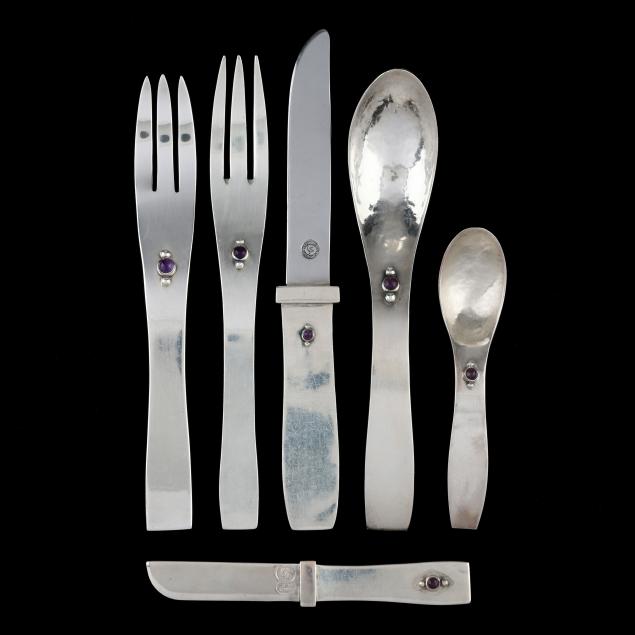
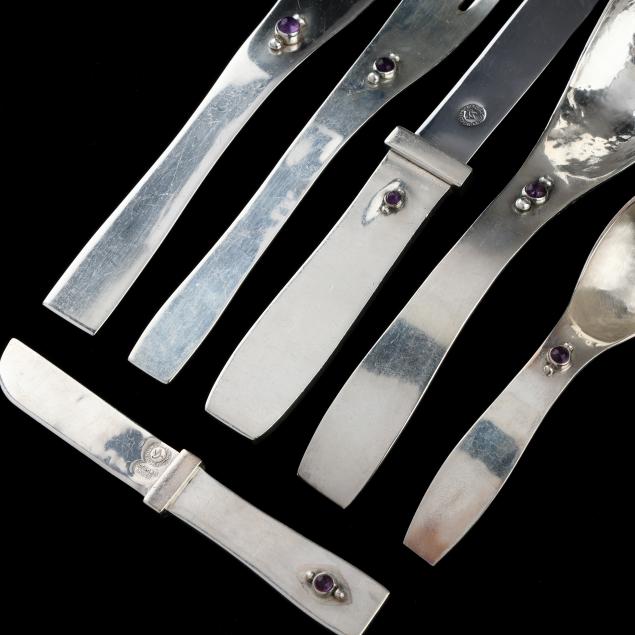
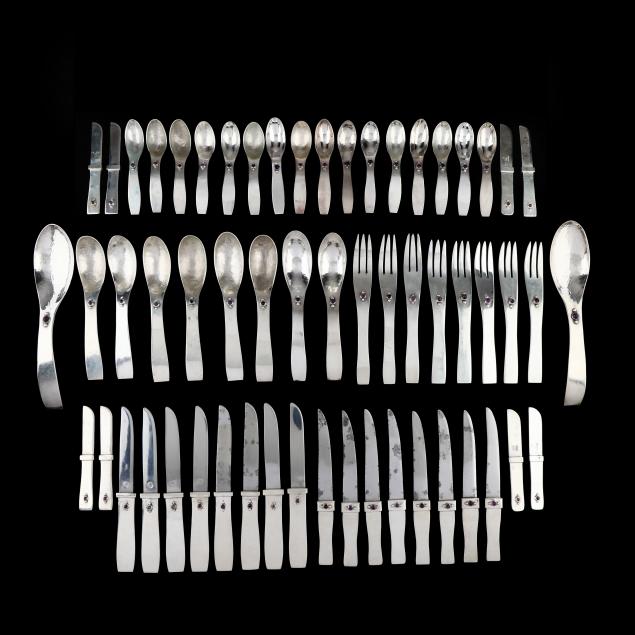
An Assembled William Spratling Silver & Amethyst Flatware Service
Explore more items like this one.
Visit our Silver Department Silver
Lot Details & Additional Photographs
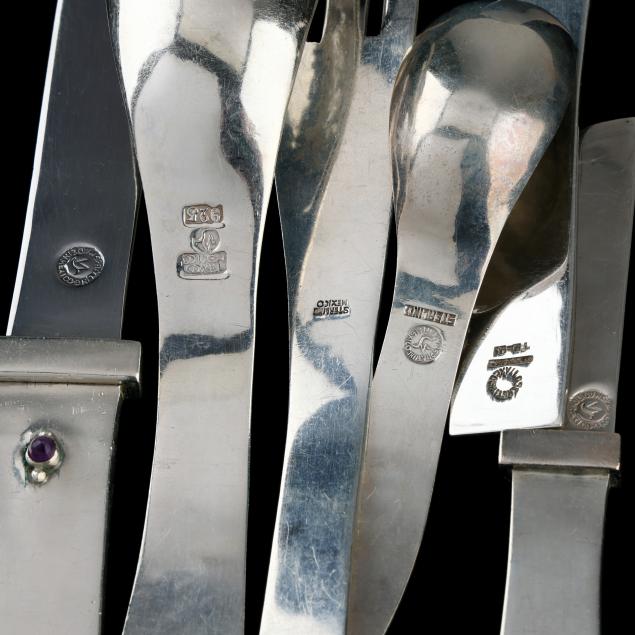
(8) knives (8 5/8 in.) - (6) blades with 1940s period Spratling mark; (2) blades have been polished and are unmarked, the handles marked “Sterling / Mexico.”
(8) knives (8 1/8 in.) - (2) blades with circa 1930s period Spratling mark; (6) blades are unmarked, the handles marked “Sterling / Mexico.”
(8) forks (7 3/4 in.) - (4) with Los Castillo TA-01 Sterling marks; (2) marked “Sterling / Mexico;” and (2) are unmarked.
(8) spoons (8 in.) - (2) with circa 1933-1938 period hallmarks and marked .925; (5) with 1944-1946 period hallmarks and marked “Sterling”; and (1) marked “Sterling.”
(16) teaspoons ( 5 1/8 in.) - (2) teaspoons have 1930s marks, one is sterling silver and the other is .980 silver; (5) teaspoons have 1950s marks and are sterling; (1) teaspoon has a Los Castillo TA-01 sterling mark; and (8) teaspoons are marked “Sterling / Mexico.”
(8) butter knives (5 1/2 in.) - (5) with circa 1940-1946 period Spratling sterling silver mark; (3) with circa 1944-1946 Spratling sterling marks.
(2) tablespoons with 1940 hallmark, .980 silver (9 3/4 in.).
137.55 total troy oz.
This service was assembled by the consignor's father during visits to Taxco, Mexico. He began the collection in the 1950s.
An example of this pattern is in the collection of the Los Angeles County Museum of Art (LACMA).
William Spratling was a visionary American-born designer and silversmith who played a pivotal role in the revival of Mexican silverwork in the 20th century. Originally trained as an architect and art historian, Spratling moved to Taxco, Mexico, in the 1930s and began collaborating with local artisans to create bold, modern designs rooted in pre-Columbian and indigenous motifs. His workshop, Taller de las Delicias, became the foundation of a thriving silver industry, mentoring a generation of Mexican silversmiths and establishing Taxco as a global center for handcrafted silver. Spratling’s pieces are celebrated for their sculptural forms, clean lines, and fusion of modernist and traditional aesthetics. His influence extended beyond design—he fostered cross-cultural exchange and elevated Mexican decorative arts on the world stage.
(2) of the larger knives and (6) of the smaller knives have had the blades ground and polished to remove rusting due to water damage.