

Lot 4008
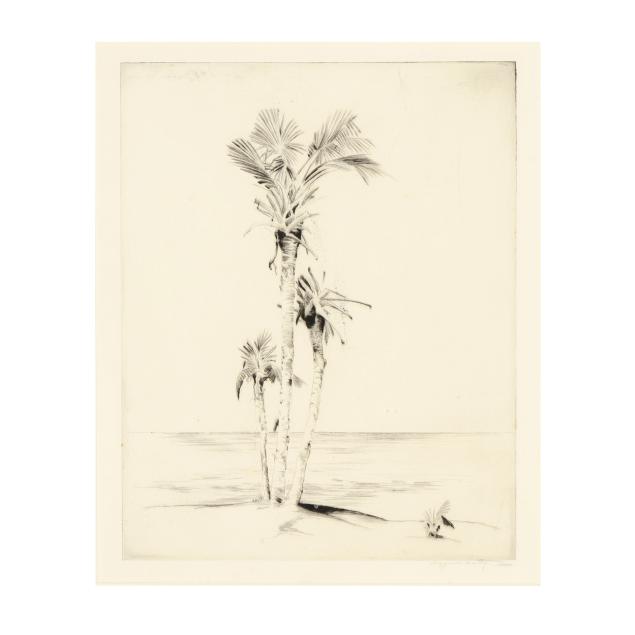
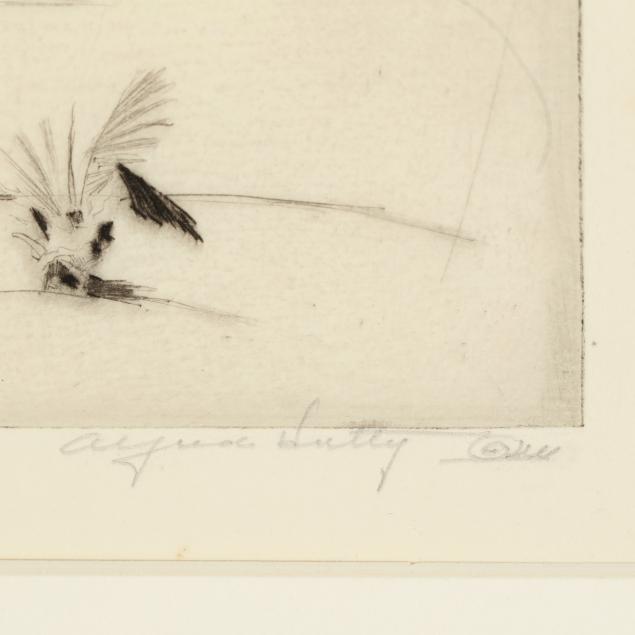
Alfred Hutty (American, 1877-1954), Solitude (Palms)
Explore more items like this one.
Visit our Prints, Multiples & Photographs Department Prints, Multiples & Photographs
Lot Details & Additional Photographs
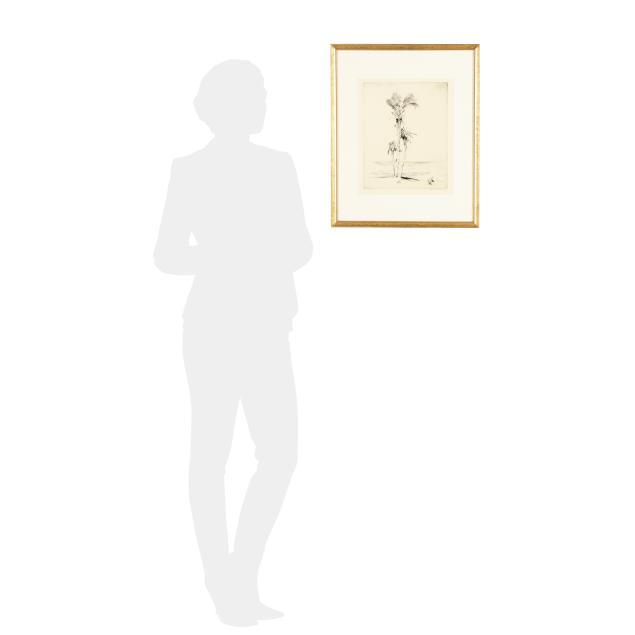
Platemark 12 1/8 x 9 3/4 in.; Frame dimensions 21 1/2 x 17 1/4 in.
Private Collection, Chapel Hill, North Carolina
Alfred Heber Hutty was born in the Midwest and received a scholarship to the Kansas City School of Fine Arts at the age of fifteen. As a young man, he was employed as a glazier, ultimately leading to employment at the Tiffany Glass Studio in New York City. In 1908, he moved to Woodstock, New York, where he studied under Birge Harrison, living in a rural home with an emerging art colony.
Hutty served as a marine camouflage artist in the First World War, before settling in Charleston, South Carolina. He became the director of the Carolina Art Association (now the Gibbes Museum of Art) and steadily became a vital part of the local cultural community, along with fellow artists Alice Ravenel Huger Smith, Elizabeth O'Neill Verner, and Anna Taylor. He was a founding member of the Charleston Etchers Club, garnering great success as a printmaker.
By 1926, Hutty was spending winters in Charleston and summers in Woodstock until his death in 1954. Throughout these decades, Hutty participated in numerous one-man and group exhibitions at national museums and was invited to membership in selective art societies. Hutty's love for Charleston is expressed by these famous words he cabled to his wife upon his first visit: "Come quickly. Have found heaven." (Adapted from The Johnson Collection)
Good condition; two minor foxing marks; not examined out of frame.