
Lot 7011
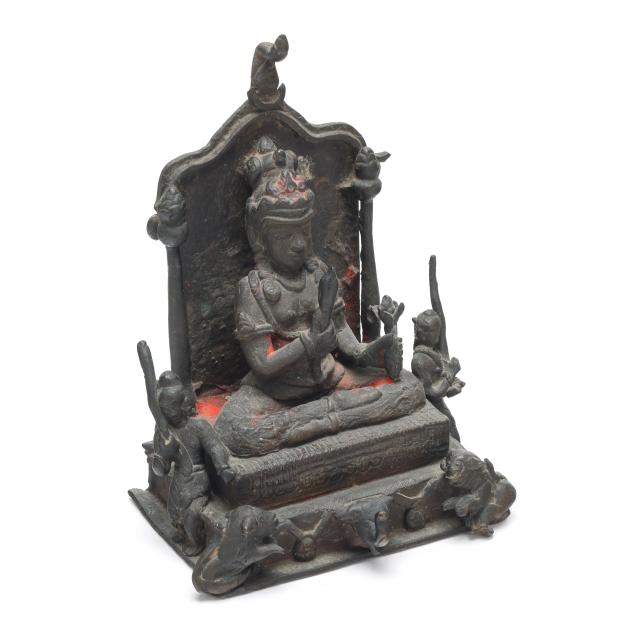
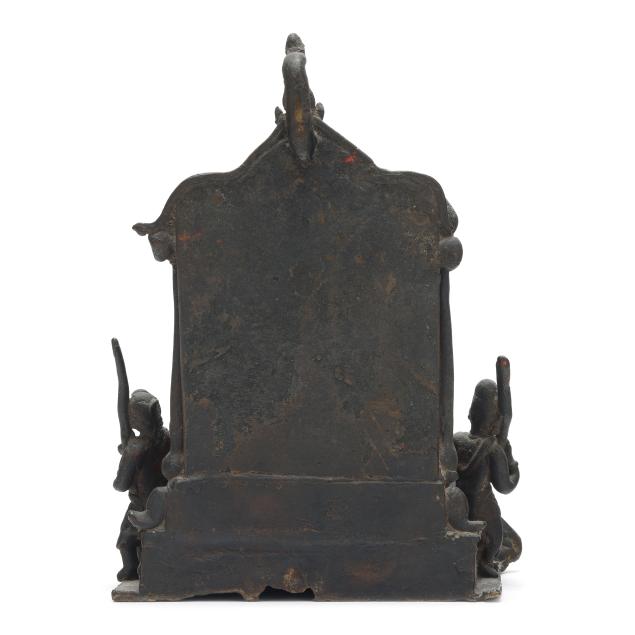
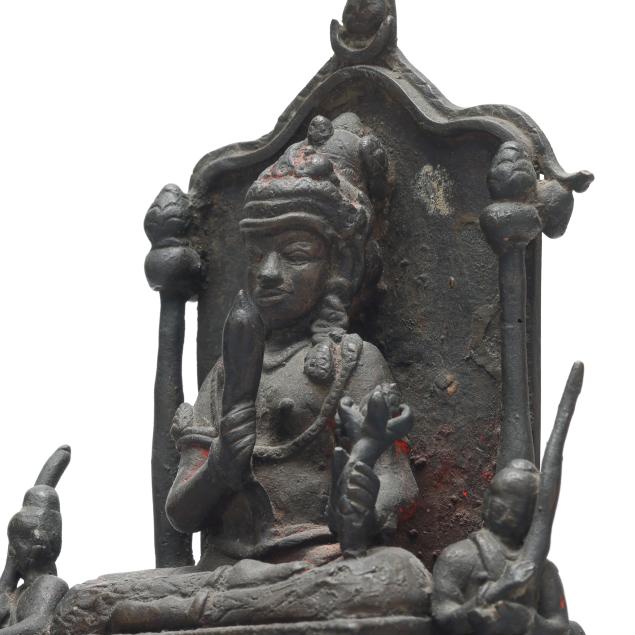
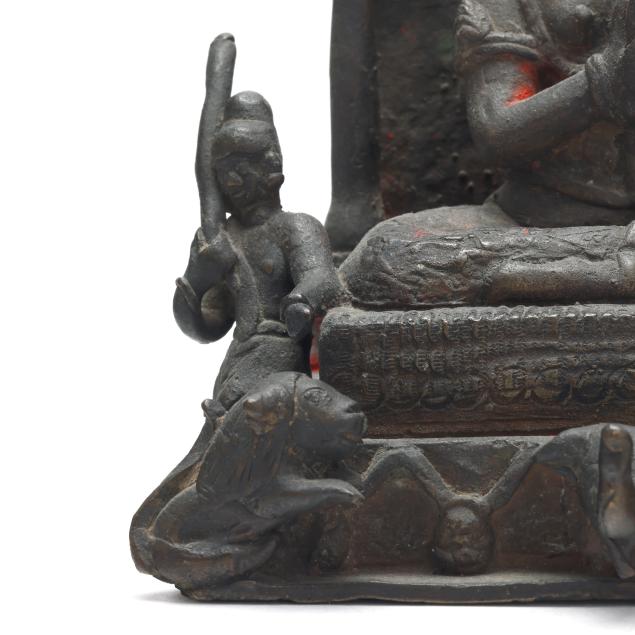
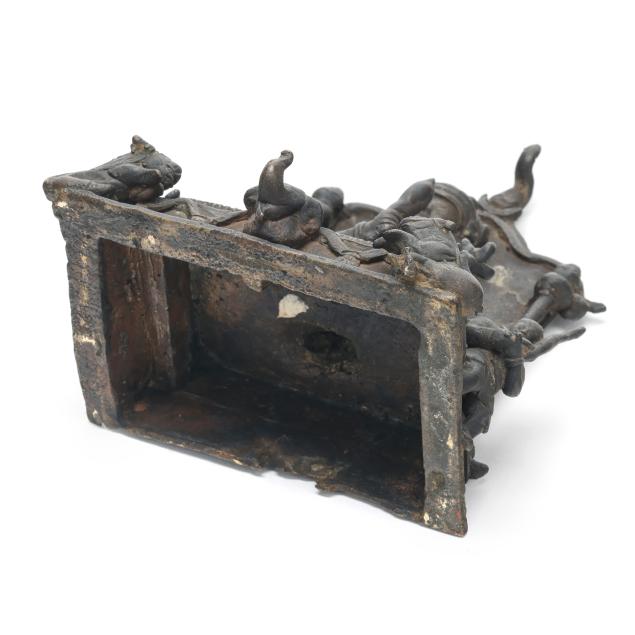
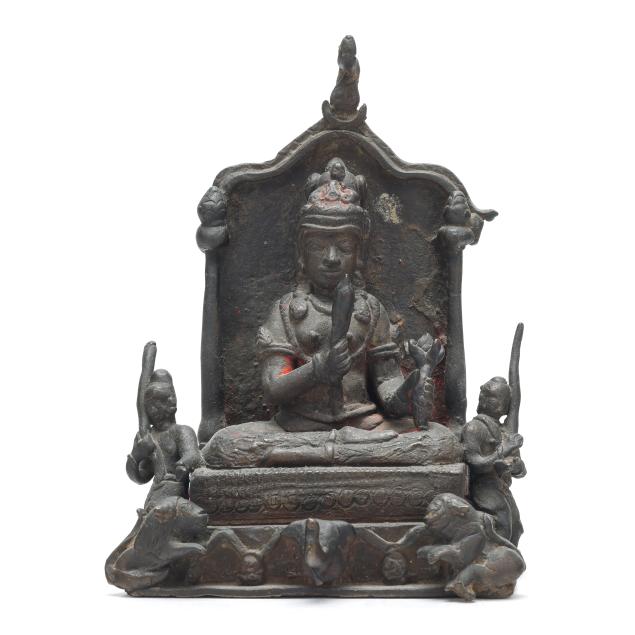
A Himalayan Bronze Female Deity Shrine Group
Lot Details & Additional Photographs
8 1/4 x 6 1/4 x 4 3/4 in.
From the Collection of William Arthur and Ferol Smith, Pennsylvania, and by descent
William Arthur Smith (1918–1989) was an American artist, illustrator, portraitist, and international cultural ambassador whose work was profoundly influenced by his experiences in Asia. He began his professional career in New York in the late 1930s, where he illustrated books, ghostwrote the comic strip Polly and Her Pals, and taught at the Grand Central School of Art. From the 1940s through the mid-1960s, his illustrations appeared frequently in The Saturday Evening Post, Cosmopolitan, and Redbook, and he created advertising art for companies including Coca-Cola, Remington, U.S. Steel, John Hancock, and Dow Chemical.
During World War II, Smith served with the Office of Strategic Services (OSS) in China. His years in China had a lasting influence on his artistic interests and his subsequent engagement with Asia. After the war, he and his wife, artist Ferol Stratton, lived in Paris from 1949 to 1951.
Smith's involvement with international art and cultural exchange expanded throughout the 1950s and 1960s. He lectured in Athens, Manila, and Warsaw and served as an official delegate to the International Association of Art in Venice in 1954. In 1958, he traveled to the Soviet Union as a member and official delegate under a cultural exchange agreement. He subsequently traveled extensively throughout Asia on State Department-sponsored cultural exchanges, lecturing and exhibiting his work in countries including the Philippines, Taiwan, Thailand, Vietnam, Burma (Myanmar), Nepal, India, Japan, and Turkey.
Smith was also a collector of Asian art, reflecting his sustained personal and professional interest in the region. He moved from New York to Pineville, Pennsylvania, in 1956. His work is held in the collections of numerous museums, including the Metropolitan Museum of Art, National Portrait Gallery, National Gallery of Art, Michener Art Museum, and Norman Rockwell Museum.
This sculpture was purchased in Kathmandu in the 1964, a well-known area of transit at that time, especially for Buddhist devotees and refugees forming the Tibetan diaspora.
The characteristics of this bronze cross cultural borders and include Swat Valley attributes and Indian Pala influences in style and iconography. Similarities such as the lion throne with flanking attendants to the central deity, the plain bronze or copper alloy without gilding, rectangular shaped base, and the arched mandorla behind the central deity. However, this sculpture is more provincial in execution, the surfaces are not as sophisticated, and the lotus blossom base is more abstract with tooling, pointing towards a later village shop made personal shrine.
Wear commensurate with age; traces of red pigment to central deity and seat.