

Lot 3085
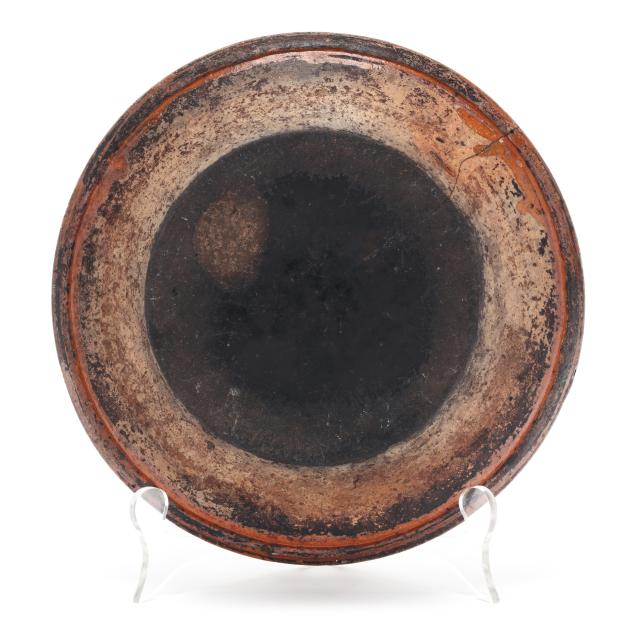
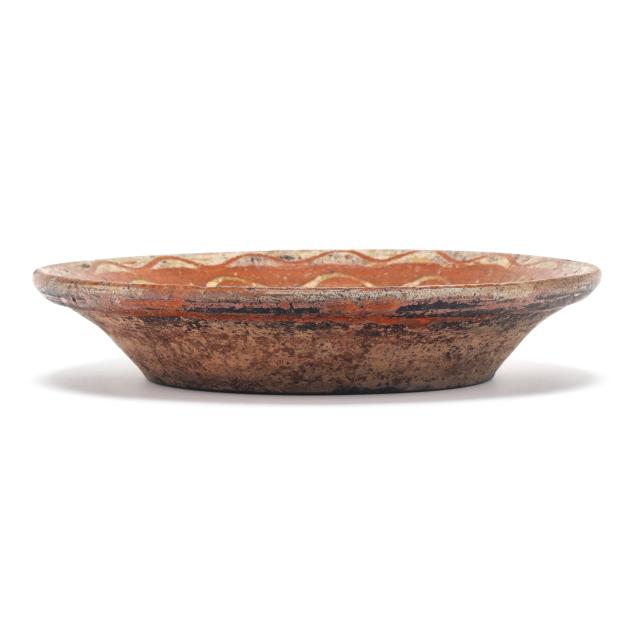
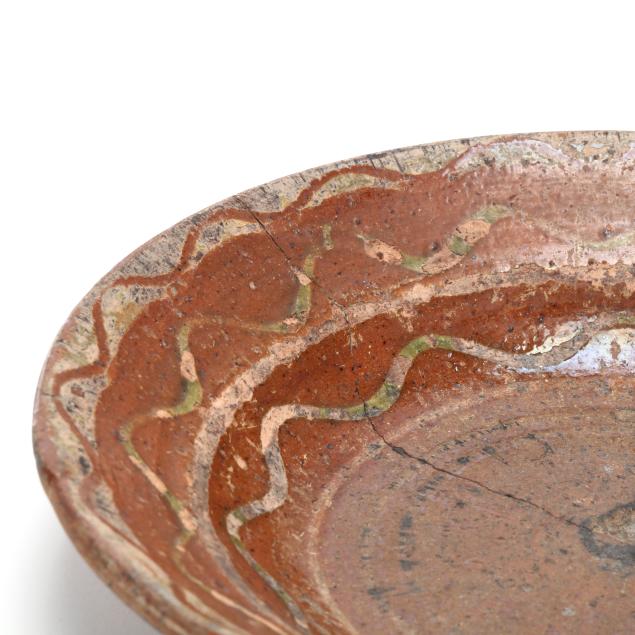
Attributed Jacob Weaver II (Lincoln County, NC, 1774-1846), Rare Slip Decorated Dish
Explore more items like this one.
Visit our Pottery & Porcelain Department Pottery & Porcelain
Lot Details & Additional Photographs
9 3/4 x 9 3/4 x 2 in.
Private Collection, Wilkesboro, North Carolina
For a similar example in the same size, see The Museum of Southern Decorative Arts (MESDA), accession no. 89.43. A distinguishing characteristic of Jacob Weaver II's pottery is the sgraffito treatment of the rim and the specific palette of alternating straight and wavy slip trailed designs. Jacob Weaver II is one of Catawba's earliest recorded potters to settle in the region. He was among several early German potters coming to North Carolina backcountry from Pennsylvania. Other potters included Christopher Culp, John Dietz, David Hartzog, John Hefner, David Mauney, Henry Miller, John Pope, Peter Reese, Daniel (and perhaps his father, Adam) Seagle, Moses Seitz, and Andrew Yount.
Earthenware from this period is inherently porous after firing, and was often sealed with a lead glaze to make it more impervious/water-tight.
Literature:
Compton, Stephen. John Wesley Carpenter: Tradition, Innovation, and Adaptation in a Shattered Post-Civil War South, published in Ceramics in America 2023 by the Chipstone Foundation.
Crack running 3/4 length across the center; obverse center with 1 in. chip; posterior center with 1 1/2 in. chip; scattered crazing and rubbing to the slip decoration.